Well, which is it? Which Tokyo suburb are we really in? Interestingly, the mission home and mission office are in the city limits of Shinjuku, while the chapel next door and our apartment (which is 150 steps away--I've counted them!) are in the city limits of Nakano! Although this can be confusing at times, it does give us double the opportunity of putting out garbage and recyclables on their appropriate days!
Where shall I start? Well, chronologically speaking, I should introduce you to
Elder and Sister Hobbs whom we replaced in mid-March!
.JPG)
They are from Salmon, ID, and have 8 children and over 30 grandchildren. The locals here got a kick out of the size difference between Elder G and 6'3" Elder Hobbs! They were great trainers and really paved the way for us to do our work here in the mission office.
Before they left we had them and President and Sister Albrecht over for lunch.
Surprisingly all six of us fit around the table!

Here is the entrance to our office.


My desk is just inside the office entry, where I get to visit with everyone who comes in the door--whether it be mailmen, delivery persons, or numerous missionaries coming and going every day. The good part is that there is always a jar of candy sitting on the counter right next to the flowers. The bad part is that there is always a jar of candy sitting on the counter right next to the flowers! The President purchases lots of candy at one of the seven Costcos in Tokyo, and I am to replenish the candy jar daily!

Elder Galbraith, however, gets his own office, removed from the flow of traffic but still in the presence of all activities that go on daily in the big room. Although the President has a separate office, too, he only uses it for interviews and meetings with his Assistants. He works mostly from his home office.
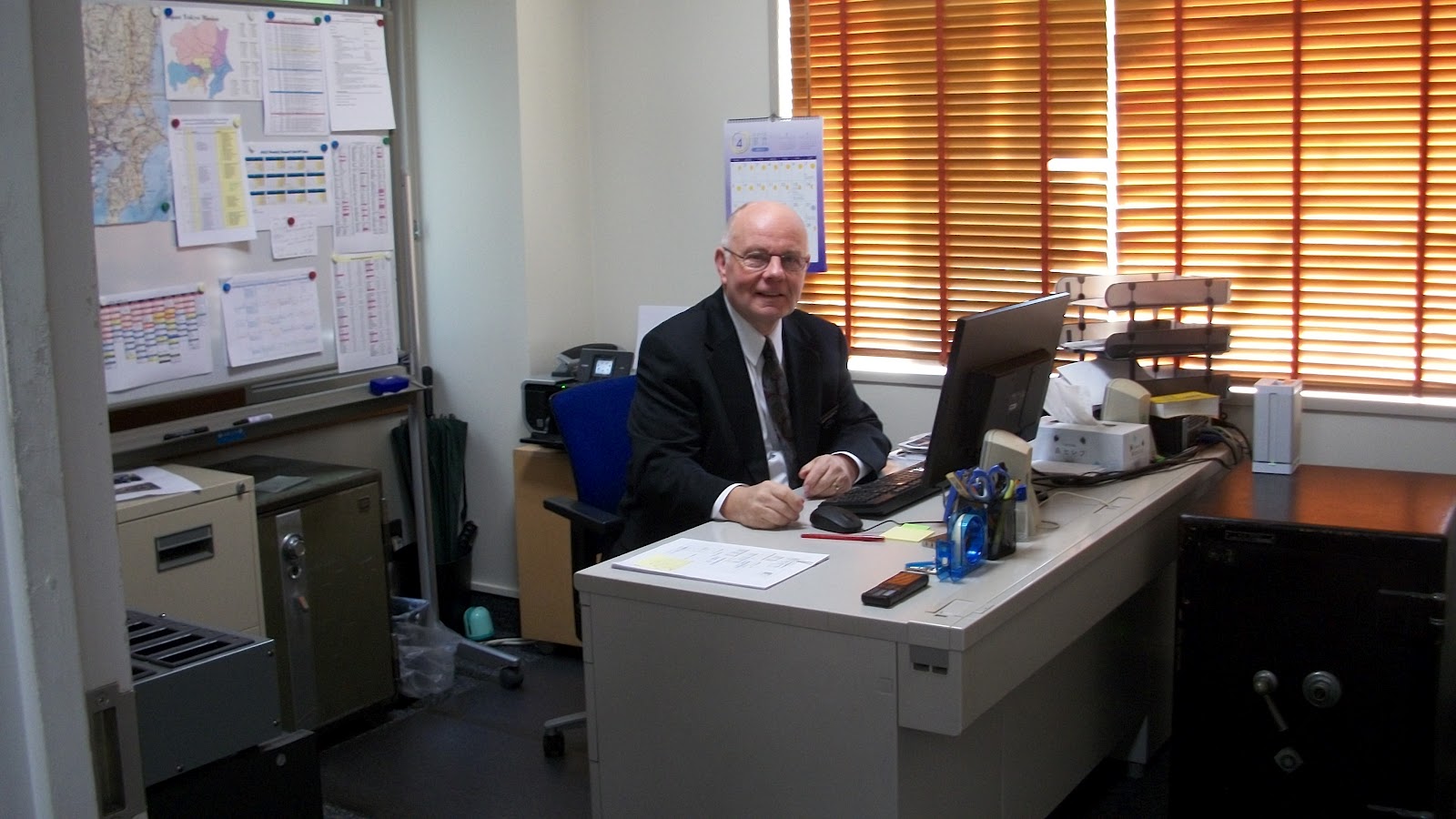
Inside the office we interact daily with five different Elders. Three of them are Assistants to the President (Cooper, Andrus, and Brown). The reason for three is that right now there would be an odd number of Elders out in the field, so the President has three in the office until the next transfer changes the odds. In addition, there are two Japanese Elders--the Recorder (Elder Eguchi, who handles all the recording of baptisms and other membership data, as well as the monthly mission newsletter, a veritable digital masterpiece, if you ask me!) and the Commissarian, Elder Nakamura, who continually orders new supplies for the mission as well as finds and furnishes new apartments as needed.
These youthful five definitely keep us feeling young--and, perhaps, sometimes older--than we really are! What a handsome bunch they all are! It will really be hard to see them leave the office when it is time for others to replace them, which is a "given." The President makes sure all Elders in the office have at least one final transfer out in the field doing actual proselyting, etc., before they return home from their mission. Elder Brown at the far right has a great-aunt in Midway, Sherry Oman (who is actually in our ward)!
Is the world small or what!!!

The mission home and chapel were actually here in the 60's when President Albrecht was a missionary! He actually boarded in the very room where Elder G and I teach the English Gospel Doctrine class.

This garden with the Japanese maple tree and stone lantern is just off the mission home dining room. The full-length windows in the mission home really make for a pleasant view. The camellia bush below bloomed a little throughout the winter, and then by spring the whole bush was in bloom!


All our missionary pictures were staged in front of this beautiful bush!

This favorite flower is a camelia.

Our church was the first one built in Japan.

The azaleas in front of the church were just awesome!
Well, from here, I should take you on a tour of our sweeeet apartment!

We are on the 2nd floor, and those are our two balconies that you see. The one on the right is off our bedroom, which is also where all our laundry is hung out to dry. There is a clothesline as well as a pole (which is too high for me to reach). The balcony on the left is off the living room and also houses our stacked washer and dryer. It's weird that it's outside, but it is covered, so I guess it's fine. Most Japanese do not own dryers; in fact, ours had to be replaced, and our Commissarian had to place an order for a new one. (They are not stocked in appliance stores!) Unlike America, they are much more expensive than washing machines. Only senior couples have dryers; the young missionaries are not given this luxury. Thanks, President!
What is so funny is that the first day we saw the 405 sq. ft. apartment--back in December when the Hobbs were still living there--we thought to ourselves, "Oh, how small!" Little did we realize that when we moved to Fussa, our apartment there would be even smaller at 378 sq. ft.! (Remember the bedroom in which I had to turn sideways in order to get around to my side of the bed?) Anyway, moving here in March made us feel like millionaires! Why this apartment even has an office! We totally love it! Here is Elder G standing with the entry/shoe porch (genkan) behind him and the entire kitchen and most of the living room in front of him!

I'm at the "bedroom end" of the living room, holding a very handy, yet powerful vacuum. And the cord is one of those retractable ones that can give you a whiplash if you don't get out of the way! The Japanese surely know how to put power and ingenuity into small things, I'm convinced! (You can see our stacked washer & dryer behind me on our covered balcony.)


What you see is what you get when it comes to kitchen counter space! That's totally all there is! It is no bigger than the one in the Fussa apartment; however, I do have a lot more cupboard space to the right.
Also, as I mentioned, we do have a great office, where we spend most of our at-home hours on the computer. The other end of the office has plenty of cupboards, which Elder G uses as his "closet" and which also hold all our linen and candy stash for English class.

The office also doubles somewhat as my extended kitchen as you can see by my 12"x12" microwave / convection oven, my 1980's crock pot, and the most-important-of-all-Japanese-appliances,
the rice cooker!
the rice cooker!

Our shower is really the only complaint we have about our apartment. Actually, it is rather a big room. But then when you find out that you can't brush your teeth or shave without the water running over your feet, you begin to wonder "What's up?" You see, both the sink and the tub drain right onto the floor! That is why there is a little platform there to stand on. Since there is running water on the floor, there is no electrical outlet in this room. Hence, if Elder G were to use an electric shaver, he would have to do so in the kitchen, which is exactly where we both brush our teeth! I tried keeping toothbrushes, hairbrush & comb, etc., in the shower room for about two days until I realized that they get soaking wet from the shower overhead! Just totally weird! (I had wondered why the Hobbs left one kitchen drawer empty when they left, but I guess they forgot to tell us that that was where they kept their bathroom supplies!)

So, we have this big room that we do nothing but shower and shave in; and then in contrast, we have this teeny tiny commode that makes an airline toilet seem spacious! I'm sure anyone over 6' tall has knees hitting the wall in front of them! But if this is all we have to complain about,
I would say we're in pretty good shape, wouldn't you?

Each morning I arise at 5:20 so I can head out the door to do my "morning routine." This consists of walking almost a mile to a nearby large park with a very nice paved walking path. I'm there before 6 a.m., and so are numerous middle-schoolers practicing baseball with their coach--even when school was out for the year-end break in March-April! Baseball is very popular here in Japan.


After one lap around the park (1500 meters), I am met by a 72-year-old ward member, Sister Kodama. She speaks about as much English as I do Japanese, so sometimes we are able to understand each other, and other times we just laugh-off our not understanding each other! She and I do another lap around the park and then head back towards home and a smaller park where a group of about 25 people meet every morning of the week to exercise for 30 minutes. Everyone is spread out across the park, not like our aerobics, where all the women are a yard apart!

The lady at the far right leads the group, counting to 40 for each of the exercises we do--all of which are the same ones in the same order every day. Most of the time that means doing 20 "reps," but some of the time it means 40. I have come to the conclusion that we move EVERY joint in our body. At first I thought my toes were the only ones not getting a workout, but then I noticed how much my toes curl into my shoes in order to keep standing on one leg while we are doing all these one-legged balance things! None of this is strenuous; however, I truly feel that moving my arms around for 30 minutes beats the possibility of getting what I've heard referred to as "relief society arms." ha!


This is definitely one exercise I omit! First of all, my knees would not allow it! Secondly, if they did, I still couldn't squat and walk around the park flat footed like they do for 40 counts!!
This last photo at the park is of my other Japanese friend, Junko. I "inherited" her from the Hobbs. I'm not sure how they originally met--probably at the park--but they were friends for their entire mission here. Before they left, they introduced me to her, and now she has "adopted" me as her gaijin friend. She, on the other hand, does know a little more English than I do Japanese; we still struggle to communicate, but we also manage to have a great time together. (She can even sing "Singing in the Rain" in English, which I can't do!) She has run 40 marathons (one in NYC in 3 hours 40 minutes); and at 75 years old, she can still outdo anyone at the park! She has given me two exercise shirts (I think she was embarrassed to see me in the same one all the time) and lots of Japanese treats. She plays the shamisen, the Japanese musical instrument that looks similar to a banjo with a three-foot neck, but that's another blog! She continually confirms with me that I'm not going back to America for at least a year! She's truly a sweetheart,
and I treasure our friendship!

We live in quite a nice neighborhood, one block off a very busy street. There is a mixture of apartments and homes. I can't resist starting with this first apartment building that must have been built for anorexic people! I still can't figure this one out! Each door has a mailbox slot, so there are definitely four units there!

I think their architecture is pretty much straight lines without much attention to attractiveness. Their old homes in the country have a lot of character, but their newer ones in the city are pretty much just functional.


I really like the next two as I feel they put a lot into their entrances.
Even as nice as these homes are, they do not have garages.
Even as nice as these homes are, they do not have garages.


I couldn't resist this one just around the corner from us; I believe it's narrower than a single car garage! If not, it's no wider than that! Quite a mixture of both sizes and styles in our neighborhood!

Believe it or not, this last shot of a dead-end, very short street ("driveway" in America) has six houses--two on each side and two at the back. It is not uncommon at all to have homes 12" - 18" apart!

Before I leave the neighborhood, I must pay tribute to the clever and not-so-clever ways of parking. I would really like to see the one below in operation! I still can't figure out how it works!

And the next two show how only one person can exit the car once it's pulled into its spot!
(Remember, right-hand drive is how it's done in Japan!)
le


I have one last note before leaving the "hood." Garbage cans are not used here. Instead, your garbage and/or your recyclables are set out on given days of the week in certain nets or plastic cartons, both of which are manually emptied by the garbage men. Personally, garbage and recycle cans like we have at home
are much more attractive!

I would like to mention how one does shopping here. The two nearest grocery stores I walk to are almost a mile either way. And, of course, that means I carry my bags home with me, so I don't do a whole lot of shopping at one time. But I'm getting ahead of myself. Let's look at a few of the items in the stores.

Note the size of the green onions! They are over 2 feet long and huge, like on steroids! And I love the Campbell's soup labels! The cost? About $2.50 per can! And cocoa is about $7.50!


But one of our favorite Japanese foods, Yaki tori (chicken on a stick) is still a great buy at 100 yen ($1.25)!

I must explain how you go through the checkout line: The checker unloads your basket of items as she scans them and puts them back into another basket on the counter. You pay for your items and then take the newly filled basket over to a counter where YOU do the bagging. I find this rather interesting! Apparently, should you bring your own shopping bag, you receive a small discount
of a few yen at some stores.

Good ole Baskin & Robbins! The 6" cakes below are $45 each!


Then there's always the Happy Meal with Japanese toys!

President & Sister Albrecht took us to a store much like a Home Depot. We couldn't get over the size of the lawnmowers! No, these are definitely not toys! The handles, however, did extend; but, dang, they are still awfully small! But since almost no one has any lawn, I'm not sure why these even exist!

Likewise, these, too, are not toys. They are pet buggies! And if you saw how much Japanese pets are favored, dressed, and taken for walks as well as rides, you'd not be so surprised!


As I was saying, pets in Japan are totally spoiled! What I first thought was a baby store is,
in fact, a pet store with clothes, toys, dishes, etc.
I must include a picture of my getting a surprise Mothers' Day cake from Elder Willard of Roosevelt, UT. He baked it in a rice cooker, and it was actually very good, kind of heavy like a pound cake. Yummy!

These two handsome "brethren" treated us to a typical Japanese lunch after coming down from Church headquarters (PBO) in Tokyo to give Elder G some training on Church finances.

They shared an order of shabu shabu, which is an assortment of raw vegetables and bacon-thin meat. Each person puts his selections into the boiling water in front of him (the center of the table is a glass stove); and then when it's cooked, he uses his chopsticks to remove the food, dip it in sauce, and then enjoy!

Elder G went with an American favorite, tonkatsu, which is a fried pork cutlet served over rice.

And I had suki yaki--meat, vegetables, and noodles--brought to me on my own personal "grill! It was a very enjoyable lunch, experiencing all three of these typical Japanese meals with new Japanese friends.

One more note about eating: I have to include last night's 45th anniversary dinner at Bubba Gumps. We loved it so much the first time around that we returned, taking President Albrecht and his wife,
LeAnn, with us. It was truly an enjoyable evening!


I'll wrap this post up with a cute note; i.e., pictures of CUTE JAPANESE KIDS.
That's one thing we all agree on over here: Japanese toddlers are as cute as can be!

.JPG)


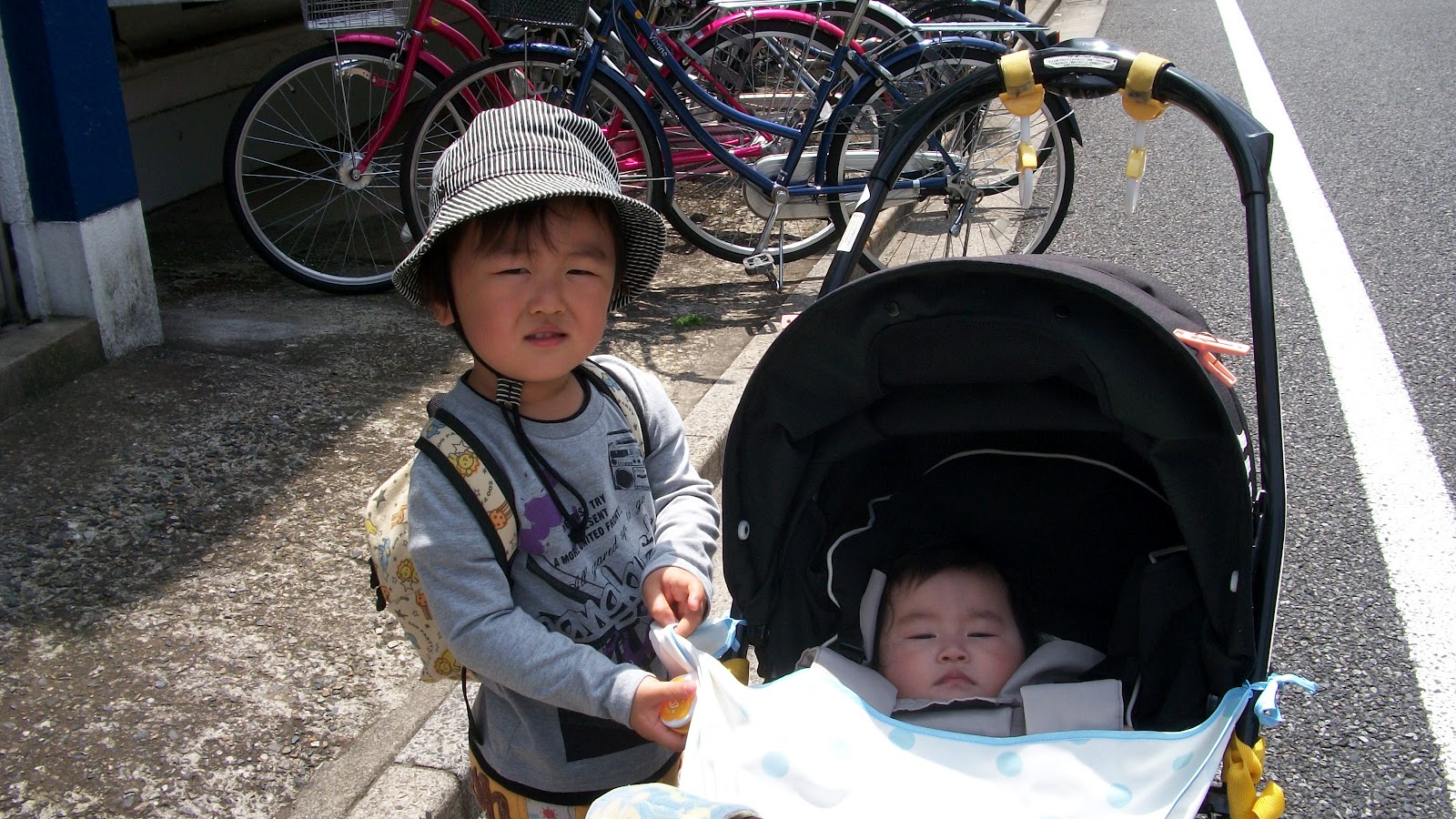

This last one is especially for Derek, Erin, and Emily in honor of our old pug, Thor! And, no, the pictures with the kids doing the "peace sign" were not prompted by the photographer!
It's just what you do if you're Japanese!!!

